
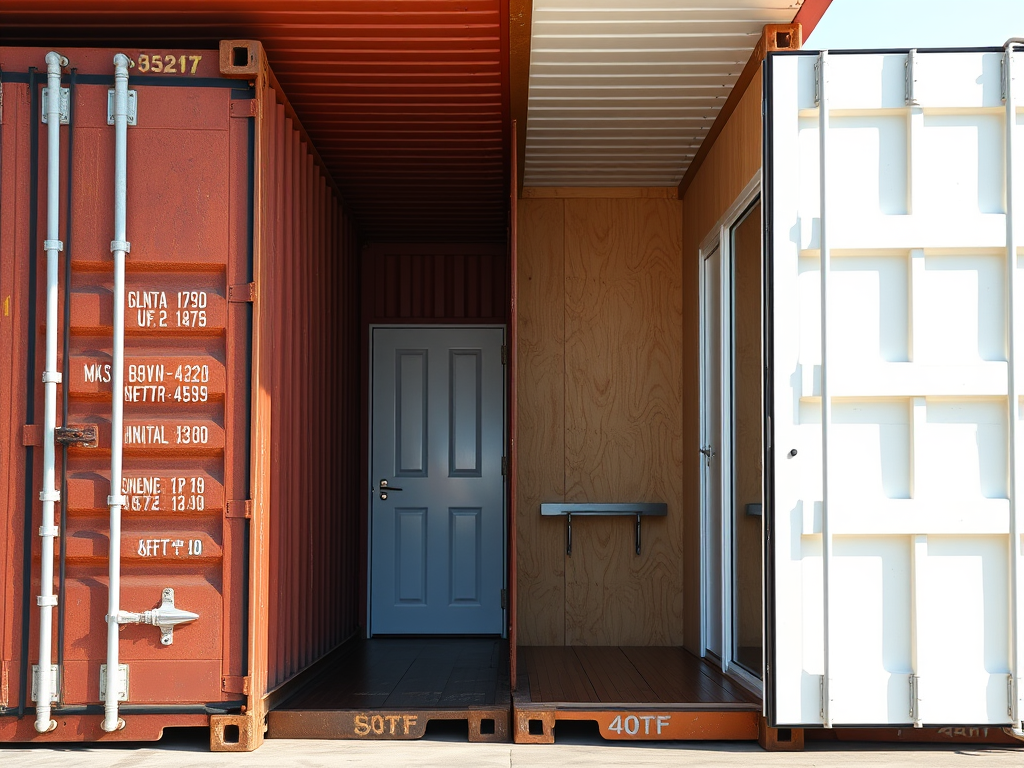
Standard Shipping Containers vs. Custom Storage Containers — Materials, Structure, Dimensions, and Freight Costs
Introduction Choosing between standard shipping containers and specially made storage containers matters for durability, fit-for-purpose design, and total cost. Below is a practical, side-by-side comparison focused on material, structural features, common dimensions, and freight cost drivers to help buyers, facility managers, and logistics planners decide.
- Purpose and overview
- Standard shipping containers: ISO intermodal units (20ft, 40ft, high-cube variants) built to carry cargo across ships, trucks, and trains. Designed for global handling, stacking, and secure transport.
- Special-made storage containers: Purpose-built units optimized for on-site storage, workshops, modular buildings, or non-standard cargo. Often modified from new or used containers or built from scratch with bespoke features.
- Materials
- Standard containers:
- Primary material: Corten (weathering) steel for walls, corner posts, and frames — chosen for strength and corrosion resistance.
- Flooring: Marine-grade plywood (treated) on steel crossmembers; some newer models use bamboo or composite boards.
- Roof and doors: Corten steel, with rubber seals and locking rods.
- Corrosion protection: Factory-applied primers and topcoats; ISO standards assume maintenance.
- Special-made storage containers:
- Options: Corten steel (common), stainless steel, galvanized steel, aluminum, or insulated sandwich panels (steel-aluminum-foam composites).
- Flooring: Treated plywood, concrete, epoxy-coated steel, or industrial vinyl.
- Added materials: Thermal insulation (PU foam, rock wool), internal cladding (plywood, OSB, steel), windows, HVAC, electrical installations, shelving, and security fittings.
- Material choice depends on intended lifespan, climate, fire-rating, and weight constraints.
- Structure and build differences
- Standard containers:
- Structural system: Corner-castings and steel frame carry stacking loads; corrugated walls provide longitudinal stiffness.
- Doors: End double doors (20/40ft) with standardized locking gear (ISO twist-lock compatible).
- Ventilation: Small passive vents; not insulated by default.
- Load capacity: Typical payloads — 20ft:
28,000 kg gross weight limit (22,000 kg payload); 40ft:30,480 kg gross (26,500 kg payload) depending on tare. - Stackability: Designed for multi-tier stacking on ship decks and in yards.
- Special-made storage containers:
- Structural variations: Can remove or add panels, cut large openings, add framed windows/doors, or build non-cube modules. If modifications remove shear panels/corner strength, structural reinforcements (steel frames, C-channels) are added.
- Insulation & finishes: Full thermal envelope and interior finishes for climate control or living spaces.
- Load & stacking: Many conversions lose certified stacking capability unless reinforced; on-site stacking usually limited or engineered.
- Security & access: Enhanced locks, roller shutters, personnel doors, or sectional doors for equipment storage.
- Dimensions & common variants
- ISO standard external dims (typical)
- 20ft Standard (1TEU): external ~20′ x 8′ x 8’6″ (6.06m x 2.44m x 2.59m); internal ~5.9m x 2.35m x 2.39m; capacity ~33 m3.
- 20ft High-Cube: uncommon; usually 40ft HC.
- 40ft Standard: external ~40′ x 8′ x 8’6″ (12.19m x 2.44m x 2.59m); internal ~12.03m x 2.35m x 2.39m; capacity ~67–76 m3.
- 40ft High-Cube (40’HC): height 9’6″ (2.90m) internal, capacity ~76–86 m3.
- Special-made storage containers:
- Can match ISO dims for transportable units, or be nonstandard (e.g., wide-body, double-height, custom lengths: 10ft, 12ft, 45ft, or modular combinations).
- Interior clearances: often reduced by insulation and lining (subtract 50–300 mm from each interior dimension depending on insulation thickness).
- Door and access variants: side doors, roll-up doors, big sectional doors, personnel doors with thresholds, internal mezzanines — dimensions tailored to intended use.
- Freight cost considerations (purchase & transport)
- Purchase price (indicative, 2025 market-relative ranges):
- Used 20ft standard (wind & wear dependent): $1,500–$4,000.
- New 20ft standard: $3,500–$6,000.
- New 40ft standard: $6,000–$10,000.
- Custom-built storage container: $6,000–$40,000+ depending on materials, insulation, MEP (mechanical/electrical/plumbing), doors/windows, and finishes.
- Transport/freight costs drivers:
- Standard containers:
- Intermodal compatibility lowers per-unit transport cost; carriers price moves per TEU or FEU; shipping lines and trucking can optimize container reuse and repositioning.
- Sea freight per TEU depends on route, rates, and seasonality — major routes may cost $800–$4,000 per TEU (market volatile). Land haul and delivery add $100–$1,000 depending on distance.
- Handling fees: terminal, chassis, lift-on/off and inland haulage standardized and generally lower for ISO sizes.
- Special-made units:
- If built to ISO external dims, sea freight cost similar to a standard box but higher due to overweight/oddity surcharges if heavier than typical cargo.
- Non-ISO dimensions, overweight, or oversized features (e.g., external HVAC units, roof structures) require special transport permits, flat-rack, or OOG (out-of-gauge) handling — costs can be multiples of standard freight (2x–10x or more depending on route and handling complexity).
- Additional transport costs include requirement for escort vehicles, crane lifts, site preparation, and permitted movement windows for oversized loads.
- Standard containers:
- On-site installation costs:
- Standard containers: minimal site prep (level pad, crane lift) — $200–$2,000 typically.
- Custom units: may require foundations, utilities hookups, trade installations — $1,000–$20,000+ depending on complexity.
- Total cost of ownership (TCO) considerations
- Durability & maintenance: Standard containers are robust long-term with routine maintenance (coating, floor repair). Custom finishes may need higher upkeep (insulation, HVAC).
- Utility & repurpose value: ISO containers retain resale/liquidation value and transportability. Highly modified units may lose intermodal value but gain site-specific utility.
- Insurance & compliance: Custom storage used for hazardous materials, cold storage, or habitation may trigger higher insurance and regulatory compliance costs.
- Practical decision guide
- Choose standard shipping containers if:
- You need low-cost, transportable storage or consistent intermodal shipping.
- You value stacking, resale, and simple site deployment.
- Budget and speed matter over comfort or special environmental control.
- Choose special-made storage containers if:
- You require insulation, climate control, customized access, or nonstandard dimensions for equipment/workshop use.
- The unit will remain static and you prioritize on-site functionality over intermodal movement.
- You need built-in utilities, security enhancements, or architectural integration.
Conclusion Standard shipping containers win on cost-efficiency, intermodal compatibility, and ruggedness. Special-made storage containers win on tailored function, comfort, and site-specific performance but carry higher upfront and transport complexity costs. Match your container choice to whether mobility and standardized handling or bespoke functionality and permanence are your priority.