
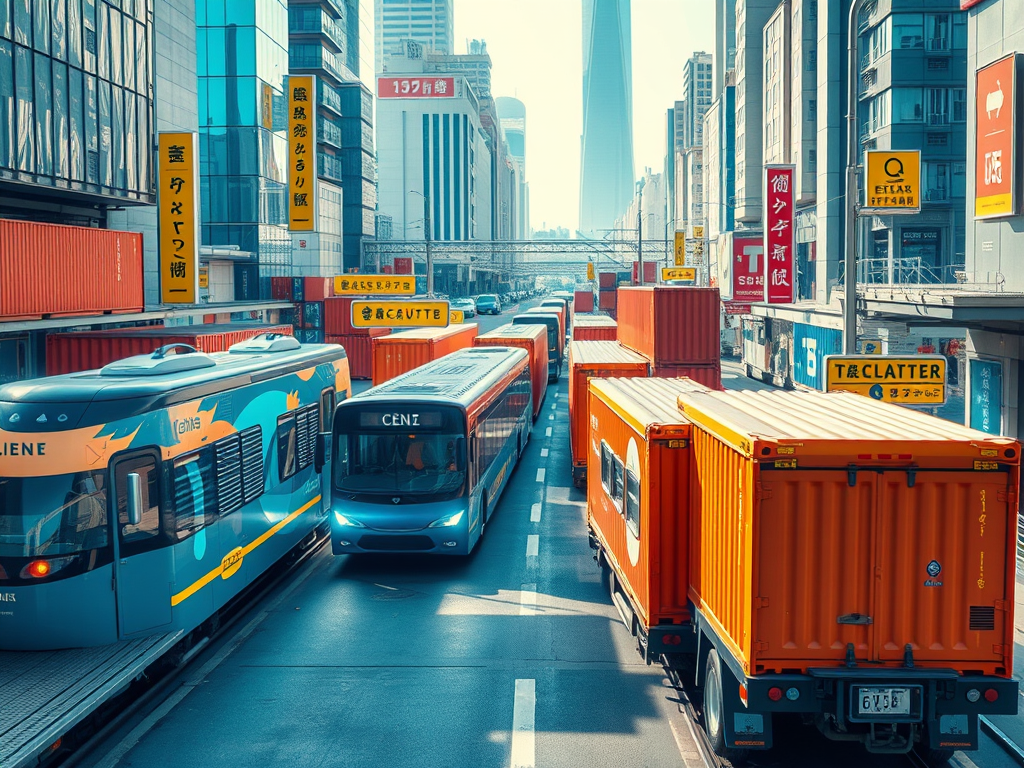
A Decade of Transformation from Container Shipping to Door-to-Door Networks (2026–2035)
Introduction Building on the earlier twenty-year outlook for container shipping, this post focuses on the future of inland trade (hinterland logistics) over 2026–2035. It quantifies key trends, cost drivers, infrastructure and technology shifts, and offers bold predictions and strategic recommendations.
- Key drivers (brief, with quantitative signals)
- Trade rebalancing: Regionalization and nearshoring likely reduce long-haul deep-sea TEU share by ~5–10 percentage points; inland and short-sea flows should grow ~1.0–1.5 percentage points per year faster than the global average.
- Urbanization & e-commerce: Last-mile costs rise as delivery density and expectations increase; last-mile share of total logistics costs could climb from 15–25% in 2025 to 20–30% by 2035 in dense urban markets.
- Carbon & fuel pressure: Carbon pricing and higher low-carbon fuel costs may raise road transport unit costs by ~10–35% (t·km basis) by 2035, depending on fuel transition speed.
- Infrastructure investment: Accelerated investment in rail and inland waterways could cut trunk multimodal costs 10–25% along key corridors.
- Mode and flow shifts (quantified)
- Multimodal uptake: With policy and subsidies, the share of containers using rail and inland waterways for deep inland moves could rise from ~18% in 2025 to ~28–35% by 2035 for relevant corridors.
- Rail growth: For medium–long hauls (>800 km), container rail volumes may grow at 3–5% CAGR, with significant demand on major corridors (e.g., Eurasia, intra-America).
- Inland waterways: Containerized river/short-sea growth of ~2–4%/year is plausible for low-value, low-urgency cargo, cutting per-TEU trunk costs by 10–30% when efficiently integrated.
- Costs and economics (example estimates)
- Example: FEU from Shanghai to a 1,200 km inland city (2025 baseline)
- Ocean to nearest port: $1,200
- Port-to-door via road: $400–$800
- Port-to-door via rail: $300–$550
- Total (road): $1,600–$2,000; (rail): $1,500–$1,750
- 2035 mid-case (carbon/fuel up, multimodal efficiency improving)
- Road total up 15–35% → $1,840–$2,700
- Rail/water total up 5–15% or stable due to scale → $1,575–$2,000
- Takeaway: Over the decade, multimodal options offer better cost resilience, especially for long-distance, high-volume inland flows.
- Technology and operational innovations
- Digital coordination platforms: End-to-end visibility (real-time box/vehicle tracking, ETA, dwell times) can cut rehandling, idle time, and detention — potentially reducing inland logistics costs 5–15%.
- Fleet electrification & hydrogen: Urban short-haul will electrify fastest; regional heavy trucks move toward hydrogen/synthetic fuels — short-term cost increases but significant urban emissions reductions.
- Automated hubs & autonomous drayage: Automated terminals, autonomous yard vehicles, and remote-controlled drayage could raise handling productivity 20–40% in high-density nodes.
- Infrastructure bottlenecks & policy levers
- Bottlenecks: low multimodal transload efficiency, limited inland terminal capacity, complex cross-border rules, urban congestion, and low-emission zones.
- Policy levers: Harmonized carbon pricing, rail/river subsidies, single-window customs, and standardized equipment/interfaces can materially shift modal economics toward lower-emission inland options.
- Risks and sensitivities
- Carbon price/fuel supply volatility: Rapid carbon price rises toward $150+/tCO2 with constrained low-carbon fuel supply would disproportionately raise road costs and stress supply chains.
- Geopolitics/trade barriers: Trade barriers or border friction reduce cross-border rail/water viability, forcing more local sourcing.
- Infrastructure underinvestment: Failure to scale hubs and last-mile capacity will keep road dominant, raising costs and emissions.
- Bold predictions (2026–2035)
- By 2030, multimodal share of long-distance inland container moves (>800 km) will at least double on principal corridors (e.g., inland China–ports, European hinterlands).
- By 2035, zero-emission vehicles will account for 35–55% of urban short-haul (<150 km) deliveries in major cities—with variation by regulation and subsidy.
- Coordinated carbon pricing will expand multimodal cost advantage by 10–20 percentage points versus a low-carbon-price scenario.
- Intelligent inland hubs will reduce container dwell times by 30–50%, easing port congestion and repositioning pressure.
- Actionable recommendations (concise)
- Governments/planners: Prioritize transload hubs, rail and inland-water investment, customs digitization, and targeted subsidies that reward modal shift and emissions reduction.
- Carriers/2PL/3PL/shippers: Embed multimodal options into S&OP, secure long-term capacity at inland hubs, invest in visibility platforms, and pilot low-emission drayage fleets.
- Investors: Favor assets and firms with hub ownership/partnerships, digital platform capabilities, and clear green transition paths.
Conclusion From 2026–2035, inland trade will shift from passively receiving sea containers to actively optimizing door-to-door networks. Costs, carbon policy, infrastructure, and digital integration will determine who gains. Stakeholders that enable multimodal flows, invest in hub intelligence, and align with decarbonization will secure long-term competitiveness; those that do not will face rising costs and reduced resilience.