
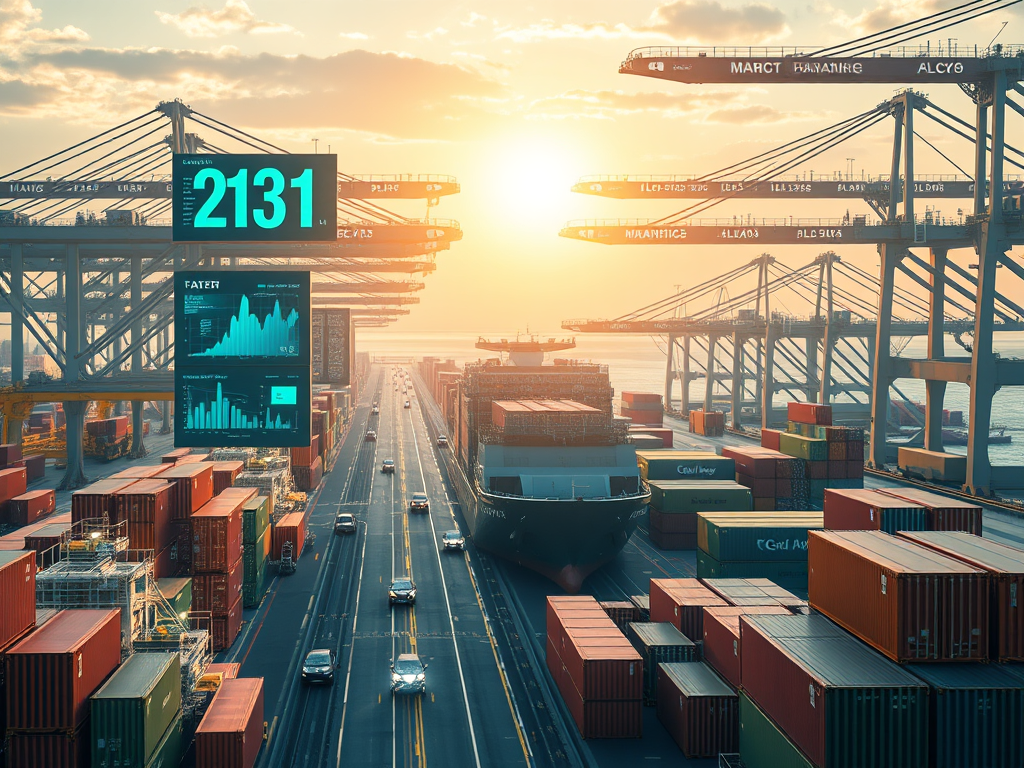
The Next Two Decades of Shipping Containers — A Numbers-Driven Look Back and a Bold Forecast Forward
Introduction Over the past decade (2016–2025) shipping containers remained the backbone of global trade, while the container sector navigated capacity shocks, rising costs, decarbonization pressures, and shifting trade patterns. This post analyzes what happened in numbers, why it matters, and offers data-driven scenarios for the next ten years (2026–2035), including bold predictions on whether the container business will thrive or falter.
Part I — The Last 10 Years: Key Numbers and Trends (2016–2025)
- Volume and trade flows
- Global container throughput grew roughly from ~700 million TEU (twenty-foot equivalent units) in 2016 to around 900–1,000 million TEU by 2023–2024 — an increase in the ballpark of 25–40% depending on year and disruption effects. Growth slowed and became uneven after 2020.
- Trade rebalancing: Asia-to-Europe and Asia-to-North America retained dominance (~60–70% of deep-sea container trade value), while intra-Asia and regional trade rose faster as nearshoring and regionalization accelerated.
- Shipping capacity and vessels
- Orderbooks surged after 2016 but were volatile: operators added many ultra-large container vessels (ULCVs) of 14,000–24,000+ TEU capacity, raising average vessel sizes and port infrastructure demands.
- Global container fleet capacity expanded ~15–25% over the decade, but effective available capacity repeatedly fluctuated due to COVID, port congestion, and idling/slow-steaming strategies.
- Freight rates and costs
- Baseline spot rates (e.g., Asia–North Europe) historically ranged $1,200–$2,500 per FEU in normal years; 2020–2021 saw spikes to $10,000–$20,000+ per FEU on many routes. By 2024–2025, rates stabilized above pre-pandemic norms, influenced by higher fuel/operational costs and tighter service networks.
- Supply-chain companies reported logistics cost increases of 20–50% during disruption peaks; persistent increases in diesel, wages, and container repositioning raised landed costs across industries.
- Environmental pressures and regulatory change
- IMO 2020 sulfur cap reduced sulfur content in marine fuels, prompting scrubber installs and fuel switching. The industry’s carbon intensity reduction targets tightened, with IMO aiming for a 40% CO2 intensity reduction by 2030 vs 2008 levels and net-zero by 2050 in policy debate.
- Investments in alternative fuels (LNG, biofuels, methanol, ammonia) and energy-efficiency technologies accelerated but remained a small share of total fuel consumption by 2025.
- Operational disruptions and resilience
- COVID-19 exposed vulnerabilities: port congestion, chassis shortages, and container imbalances; container dwell times and box shortages created revenue volatility.
- Digitalization adoption increased (e-documents, port community systems), but full end-to-end visibility remained incomplete.
Part II — Drivers Shaping the Next 10 Years (2026–2035)
- Trade geopolitics and patterns
- Continued regionalization: nearshoring and friend-shoring likely reduce the share of ultra-long-haul flows (e.g., Asia→Europe/US) by several percentage points, replaced by growth in intra-regional and short-sea trades.
- Diversification of manufacturing (Southeast Asia, India, Mexico, Eastern Europe) will re-route container flows and change peak seasonality.
- Economics and freight-cost structure
- Fuel and carbon prices: rising carbon prices (explicit or implicit via regulation) and higher low-carbon fuel costs will push average per-TEU shipping operational costs up 15–40% by 2035 in many scenarios unless low-cost scalable alternative fuels/technologies emerge.
- Automation and digitalization can lower terminal and inland handling costs by 10–30% in mature ports but require upfront capital.
- Environmental regulation and tech
- Stricter emission standards will force retrofits, newbuild specs, and fuel transitions. If green fuels scale slowly, expect higher shipping fares and possible modal shifts.
- Electrification for short-sea and feeder vessels, hydrogen/ammonia for larger ships, and energy-efficiency technologies will become mainstream by the early 2030s if policy, capital, and fuel supply align.
- Container lifecycle and circularity
- Reuse, standardization, and smarter tracking (IoT, blockchain for documents) will improve box utilization and reduce lost/damaged container costs — potential 5–15% improvements in effective fleet availability.
Part III — Projections and Scenarios (Numbers and Outcomes)
Scenario A — Optimistic: Green, Digital, and Regional Balance (50% probability)
- Global container throughput grows 2.5–3.5% CAGR (2026–2035), reaching 1.2–1.4 billion TEU by 2035.
- Average freight rates rise moderately (real terms) 10–25% by 2035, offset by efficiency gains and scale.
- Decarbonization: 30–45% of fuel mix replaced with low/zero-carbon fuels by 2035 in deepwater shipping, with cap-and-trade and subsidies accelerating adoption.
- Outcome: Container industry thrives. Higher service reliability and digital integration lower total landed logistics costs for many shippers even as freight per-TEU rises.
Scenario B — Middle Ground: Cost Pressure, Slow Fuel Transition (30% probability)
- Throughput CAGR ~1.5–2.5%, reaching ~1.1–1.3 billion TEU by 2035.
- Freight rates up 20–50% nominal by 2035 due to fuel and carbon costs; episodic volatility continues.
- Fuel transition limited (~10–20% low-carbon share by 2035); many operators invest in efficiency and slow-steaming to comply with emissions targets.
- Outcome: Container business survives but margins compress for smaller carriers; consolidation continues; shippers absorb higher logistics costs or reorganize supply chains.
Scenario C — Pessimistic: Fragmentation and Cost Shock (20% probability)
- Throughput stagnates or grows <1% CAGR (2035 volumes near 2025 levels) as trade barriers and deep deglobalization reduce long-haul container flows.
- Freight rates spike and remain elevated (50–100%+ above pre-2020 norms), driven by fuel scarcity, carbon pricing, and insufficient green-fuel supply.
- Outcome: Large-capacity ULCV model becomes riskier; many operators shrink or fail; increased modal shift to air for high-value goods and to regional logistics for bulk items; container industry contracts and consolidates sharply.
Part IV — Bold Predictions (short, sharp)
- By 2030 at least one top-10 carrier will have 30–40% of its fuel consumption from non-fossil fuels (bio/LNG/methanol/ammonia blends) — failure to do so will lead to market penalties or exclusion from certain ports/markets.
- Global containerized trade will reorient: intra- and intra-regional TEU share will increase by ~10 percentage points vs long-haul deep-sea share by 2035.
- Per-TEU landed logistics costs will be 15–35% higher in real terms by 2035 unless governments subsidize green shipping fuel at scale.
- A major port (or cluster) will fully operationalize autonomous/robotic terminals for ≥30% of handling capacity by 2032, cutting terminal labor costs and congestion-related delays meaningfully for adopters.
- The industry will undergo another consolidation wave; the top 5–7 integrated carriers/linemasters will control >60% of deep-sea capacity by 2035.
Implications for Stakeholders
- Carriers: Need to invest selectively in low-carbon fuels, digital visibility, and flexible networks. Over-investing in ULCVs without route demand could be fatal.
- Shippers: Must model higher freight and carbon costs into sourcing decisions; diversify suppliers regionally to control risk.
- Ports/terminals: Invest in electrification, crane automation, and hinterland connectivity — or risk losing calls to more capable hubs.
- Investors: Favor carriers/terminals with clear green transition plans, diversified route portfolios, and digital platforms enabling higher asset utilization.
Conclusion — Success or Failure? The container business is unlikely to “fail” globally — containers are too entrenched and efficient for general cargo. But the industry will transform: winners will be carriers and ports that balance decarbonization, digitalization, and network flexibility. Losers will be those that double down on scale-only strategies (pure ULCV exposure) or ignore fuel/regulatory transitions. In short: success is conditional — dependent on timely investment in fuels, technology, and regional adaptability.
In next post, I will focus on changes for inland trade. Leave a comment, share your thoughts.